

Lost Signal: How Solar Activity Silenced Earth's Radiation

Researchers from HSE University and the Space Research Institute of the Russian Academy of Sciences analysed seven years of data from the ERG (Arase) satellite and, for the first time, provided a detailed description of a new type of radio emission from near-Earth space—the hectometric continuum, first discovered in 2017. The researchers found that this radiation appears a few hours after sunset and disappears one to three hours after sunrise. It was most frequently observed during the summer months and less often in spring and autumn. However, by mid-2022, when the Sun entered a phase of increased activity, the radiation had completely vanished—though the scientists believe the signal may reappear in the future. The study has been published in the Journal of Geophysical Research: Space Physics.
The Earth constantly emits radio waves—natural electromagnetic signals that occur in near-Earth space. Analysing these emissions helps scientists better understand how the Sun influences the magnetosphere, the region surrounding our planet where the magnetic field protects it from external forces.
Various types of radio emissions originate from within this region, one of which is the hectometric continuum (HMC), a narrowband natural radiation in the range of 600–1700 kHz—significantly lower than the broadcast frequencies of conventional radio stations. The sources of this radiation are located relatively close to Earth, at altitudes of about one to two Earth radii, where the magnetic field still governs the motion of charged particles. Such waves cannot be detected from the Earth's surface, as the dense layers of the ionosphere completely absorb them. Therefore, the HMC can only be observed with the help of spacecraft. For this reason, the hectometric continuum was discovered relatively recently—in 2017—by the Japanese ERG (Arase) satellite. Since then, the signal has been recorded only sporadically, and a complete picture of its behaviour has yet to be established.
To characterise the properties of the HMC and uncover the mechanism behind its occurrence, researchers from the Space Research Institute of the Russian Academy of Sciences and the HSE Faculty of Physics compiled all available satellite data to examine how this radiation evolved over time. To accomplish this, the scientists analysed about a thousand HMC observations collected between 2017 and 2023.
The results showed that the appearance of the signal is linked to processes occurring in the near-Earth plasma—a region filled with charged particles that move under the influence of Earth’s magnetic field and the solar wind. According to the authors, the hectometric continuum arises from a phenomenon known as double plasma resonance, in which two types of oscillations in the plasma coincide: the plasma’s natural oscillations and the rotation of electrons around Earth’s magnetic field lines. This resonance creates an instability that causes the plasma to emit radio waves. Such emission requires specific conditions—a certain plasma density and the presence of high-energy, or 'hot,' electrons.
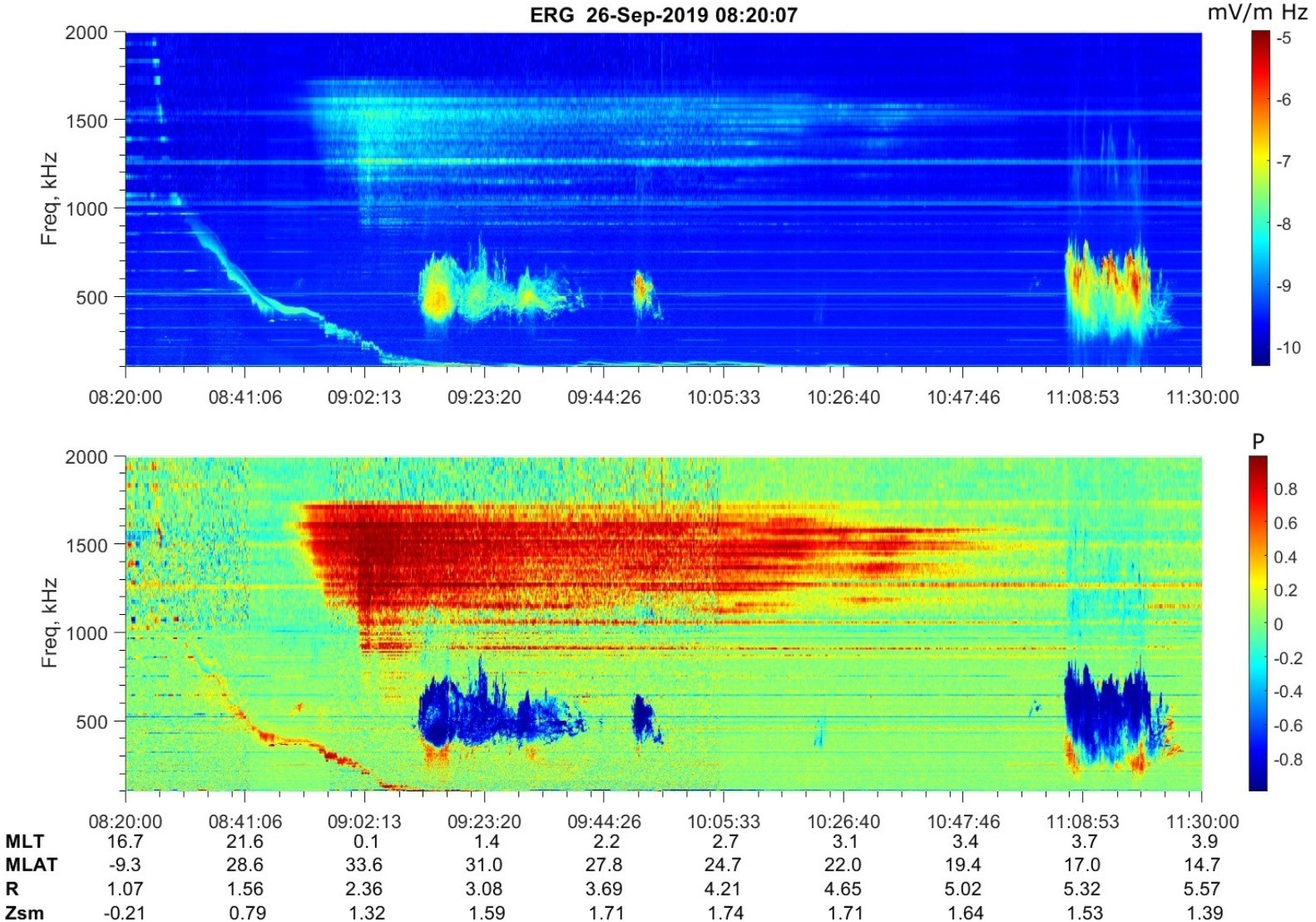
The researchers found that the radiation occurs only at night and disappears one to three hours after sunrise. They explain this by noting that morning solar radiation increases the plasma density, disrupting the conditions necessary for radio wave generation. Similarly, the signal does not appear immediately after sunset but only a few hours later, once the ionosphere has cooled and restored the conditions required to excite the HMC.
In addition to the daily cycle, the radiation exhibits seasonal variations: it was observed more frequently in summer and less often in spring and autumn. Since mid-2022, the signal has disappeared. The scientists attribute this to the Sun entering a more active phase, during which its surface showed more sunspots, radio emissions at a wavelength of 10.7 cm increased, and ultraviolet radiation levels rose. These changes altered the structure of the plasma, eliminating the conditions necessary for HMC generation.

Alexander Chernyshov
'Interestingly, unlike other radio signals that are amplified during bursts of solar activity—such as auroral kilometric radiation associated with auroras—the hectometric continuum, in contrast, diminishes. Therefore, we expect that it may reappear in a few years, when solar activity declines,' comments Alexander Chernyshov, Associate Professor at the Joint Department of Space Physics with the Space Research Institute (RAS).
The study not only contributes to a better understanding of Earth’s magnetosphere but also opens the possibility of testing whether similar radio emissions occur on exoplanets. Such emissions could indicate the presence of a planetary magnetic field, an important factor for preserving an atmosphere and, potentially, supporting the existence of life.

See also:

Scientists Train Neural Network to Generate Process Plans from 3D Models
Researchers at the HSE FCS AI and Digital Science Institute have developed CAD2TechSpec, a framework that converts 3D models of mechanical parts into machining process plans—step-by-step instructions for machine tools. The solution aims to reduce the time required for the design and preparation of technical process documentation in mechanical engineering, aircraft manufacturing, and other high-tech industries. The study findings have been published in PeerJ Computer Science.
Biologists Discover 'Molecular Fingerprint' of Preeclampsia
Researchers at HSE University employed a new method to model hypoxia in placental cells during pregnancies complicated by preeclampsia and identified molecular markers of tissue hypoxia. Since hypoxia is one of the key mechanisms underlying preeclampsia, these findings are important for a more accurate and timely diagnosis of the disease and for the development of effective treatment methods. The paper has been published in Placenta.
‘Hedgehog’ Versus ‘Relatives’: Researchers Measure How the Brain Responds to Unexpected Words During Natural Speech
Russian neurophysiologists, including researchers from HSE University, have demonstrated the feasibility of using event-related fields (ERFs) to study brain activity during natural speech perception. The researchers showed that this approach can be applied not only to individual words but also to continuous speech. Their findings indicate that words whose meanings differ significantly from the preceding context require longer processing times. The study also reveals that the brain processes function words in two stages: first, it identifies their grammatical role and then uses this information to predict the next word. The study has been published in Frontiers in Human Neuroscience.
HSE Researchers Create New Corpus of Early Child Speech in Russian
Researchers at the HSE Centre for Language and Brain have presented RusLan-M, an open multimedia corpus that makes it possible to trace the development of early child speech in Russian from first words to the emergence of complex grammatical constructions. The database contains around 41 hours of video recordings and more than 35,000 child utterances. The new resource will help researchers study more precisely how children acquire Russian and, in the longer term, develop more reliable tools for assessing speech development. The study has been published in Language Resources and Evaluation.
Hybrid Intelligence: Competencies in the Age of AI Discussed at Technoprom-2026
Artificial intelligence is not creating new professions, but rather transforming the nature of existing ones. This was the conclusion reached by participants in the panel session ‘Hybrid Intelligence: Digital and Human Drivers of Development,’ organised by the Institute for Statistical Studies and Economics of Knowledge (ISSEK) at HSE University as part of the 13th International Forum of Technological Development (Technoprom-2026). The experts discussed how the nature of work is changing, which skills are becoming increasingly sought after, and what prevents companies from fully capitalising on new technologies.
Scientists Develop New Solution for 6G Communication Systems
A terahertz neuromorphic circuit developed by scientists at HSE University could make 6G communication systems both more accurate and energy-efficient. The circuit enables indoor tracking of mobile devices with an accuracy of up to 99%. The results were presented at PIERS 2026, an international symposium on Photonics and Electromagnetism held in China.
Scientists Develop Algorithm for More Reliable Processors in Data Centres
Researchers from HSE MIEM and Samara University have developed the LRF-3D algorithm to automatically bypass idle nodes in three-dimensional networks-on-chip. Thanks to its hierarchical architecture, the algorithm outperforms existing solutions in both speed and path accuracy, improving processor reliability for use in data centres, supercomputers, and AI computing. The source code and test results are publicly available.
Researchers Rank Recommendation Algorithms Using Sports Tournament Model
Researchers from the AI and Digital Science Institute at the HSE Faculty of Computer Science have developed an approach for selecting recommendation algorithms more effectively. Their approach uses pairwise comparisons of algorithms to create a tournament table, with the overall ranking based on their performance across all datasets in the tournament. This can reduce the number of algorithms that need to be tested when developing new services, saving both time and money. The study was presented at the 32nd ACM SIGKDD Conference on Knowledge Discovery and Data Mining (KDD 2026).
Researchers Develop Method for Direct Generation of Regulatory DNA
Researchers at HSE University have developed a model for generating promoters and enhancers—DNA sequences that regulate gene activity. The model works directly with DNA nucleotides, without first transforming them into a continuous numerical representation. This solution could be useful for applications in synthetic biology and gene therapy. The study results were presented at the ICLR 2026 Workshop ‘Generative AI in Genomics (Gen^2): Barriers and Frontiers.’
Researchers at HSE University and Sber Train Neural Networks to Better Predict User Preferences
The HSE FCS AI and Digital Science Institute and Sber have introduced a new architecture for recommendation systems that combines two classes of models, enabling algorithms to better predict users’ interests and needs. A preprint of the paper has been published on arxiv.org and presented at Urban ML.