

Physicists Propose New Mechanism to Enhance Superconductivity with 'Quantum Glue'

A team of researchers, including scientists from HSE MIEM, has demonstrated that defects in a material can enhance, rather than hinder, superconductivity. This occurs through interaction between defective and cleaner regions, which creates a 'quantum glue'—a uniform component that binds distinct superconducting regions into a single network. Calculations confirm that this mechanism could aid in developing superconductors that operate at higher temperatures. The study has been published in Communications Physics.
Superconductivity is a state in which electric current flows through a material without resistance, losing no energy as heat. In ordinary conductors, electrons move independently and lose energy through collisions with atoms and impurities. In superconductors, however, electrons form Cooper pairs and move in unison, enabling current to flow without loss. Thanks to this property, superconductors are used to create powerful magnets, medical MRI scanners, and particle accelerators, and they also hold promise for developing new types of computing devices.
The challenge is that superconductivity usually occurs only at very low temperatures and is easily disrupted by impurities and defects in the material. These defects fragment superconductivity into isolated regions that fail to connect. Paradoxically, however, such disordered areas can also support the formation of Cooper pairs at higher temperatures. This creates a contradiction: structural disorder can locally enhance superconductivity, yet at the same time prevents it from spreading throughout the entire sample.
A team of researchers from HSE University, the Moscow Centre for Advanced Studies, and the Federal University of Pernambuco has shown that this challenge can be addressed by combining defective ('dirty') and clean subsystems. The team studied a two-band model in which one subsystem is highly disordered: superconductivity emerges there at higher temperatures, but only in isolated regions. The other subsystem remains clean, where superconductivity is weaker but provides connectivity. When the two are combined, a component arises that acts as a 'quantum glue,' linking the isolated islands and enabling current to flow through the entire sample at elevated temperatures.
Alexei Vagov
'Our calculations show that when defective and clean regions are properly connected, the material exhibits both a higher superconducting transition temperature and the ability to carry current without resistance. While disorder usually destroys this effect, we observed the opposite: defects can serve as a resource for creating more stable superconductors that operate at higher temperatures,' explains Alexey Vagov, Professor at HSE MIEM and co-author of the study.
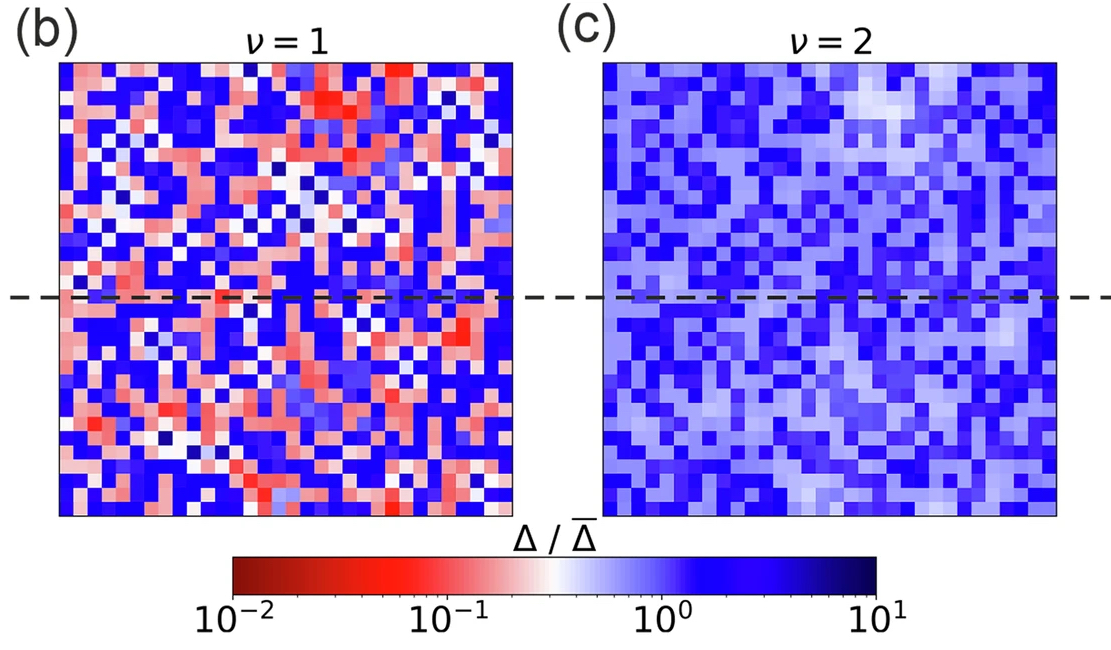
Calculations confirm that this approach is effective for various types of disorder, ranging from random impurities to specially engineered superlattices. It is particularly promising for multilayer materials, where clean and disordered layers can be alternated; for compounds based on magnesium and boron (MgB₂), in which one electronic band enhances local superconductivity while the other facilitates current flow; and for materials with flat electronic bands, where electron pairing occurs more readily. Graphene- and graphite-based systems are also considered promising, as regular superstructures can form that alter electronic properties and promote stronger superconductivity. In the future, this could enable the development of materials in which defects and impurities do not hinder, but rather enhance, superconductivity.
The study was conducted with support from the Russian Science Foundation (Project 075-15-2025-010) and the HSE Basic Research Programme, using the university's HPC cluster.

See also:

HSE Economists Use Search Queries to Forecast Birth Rates
Researchers from the HSE Faculty of Economic Sciences have shown that the accuracy of birth rate forecasts for Russia can be improved by almost 50% by incorporating the dynamics of online search queries related to pregnancy and childbirth into forecasting models. In the best-performing models, the forecasting error fell from 4.6% to 3.2%. The findings have been published in Populations and Economics.
HSE Researchers Discover Who Eats Out in Russia—And Why
Around one-third of Russians (31.3%) rarely eat out or buy ready-made meals. The core group of active consumers—those who eat out or purchase prepared food almost every day or several times a week—accounts for only about 9% of the population. These are the findings of a study conducted by the HSE Institute for Social Policy. According to the researchers eating out is no longer a marker of high social status in Russia.
Scientists Model How Interactions Between Societies Can Trigger Chaotic Behaviour
Scientists at HSE MIEM have proposed a mathematical model explaining how interactions between societies can influence their stability. Based on the classical theory of evolutionary games, the study reveals an unexpected effect: even a weak informational influence of one society on another can cause one society to remain stable while the other exhibits chaotic behaviour among its individual members. The study has been published in the International Journal of Bifurcation and Chaos.
Ancient Craniiform Brachiopod: A Newly Discovered Species with a Unique Shell Shape and Lifestyle
Scientists from HSE University, MSU, and Tallinn University of Technology have studied a fossil species of ancient brachiopods that lived in a warm sea in what is now northern Estonia more than 445 million years ago. These ancient brachiopods developed a cup-shaped shell with a protective 'cap' that shielded them from overgrowth by other marine organisms. The study has been published in Palaeogeography, Palaeoclimatology, Palaeoecology.
Scientists Develop Bacterium-Sized Microlaser
An international team of researchers, including scientists from HSE University–St Petersburg, has developed microlasers that emit deep-ultraviolet light at a wavelength of 255 nanometres. The devices operate at room temperature, and the smallest of them measures just two micrometres in diameter—roughly the size of a bacterium. These microlasers could be used in sensors, spectroscopic systems, photonic chips, and communication devices. The paper has been published in Optics & Laser Technology.
HSE Develops App for Assessing Phonological Processing in Children
Researchers at the HSE Centre for Language and Brain have developed a new digital tool for assessing children's phonological processing skills—the ZARYA (Sound Analysis of the Russian Language) test battery. It is the first standardised application in Russia designed to provide a fast and reliable assessment of children's ability to distinguish speech sounds, retain them in working memory, and perform phonemic analysis. The app runs on Android tablets and smartphones and is available for download from RuStore. Details of the test validation have been published in the Journal of Speech, Language, and Hearing Research.
Researchers Discover How Spelling Errors Slow Down Reading in Russian
Psycholinguists from the Centre for Language and Brain at HSE University–St Petersburg have shown that words that are frequently misspelled are processed more slowly by readers, even when presented with the correct spelling. The researchers confirmed this effect for the first time using Russian-language materials and found that response speed is most strongly linked to how confidently individuals can distinguish the correct spelling of a word from an incorrect one. The study has been published in The Mental Lexicon.
Scientists Discover Why Europium 'Misbehaves'
Europium is a rare-earth metal responsible for the pure red glow in displays and other luminescent materials. For a long time, however, it refused to emit light when surrounded by certain organic molecules known as acylpyrazolone ligands. Chemists have now uncovered the reason: in europium complexes with these ligands, a 'black window' appears—a charge-transfer state in which the energy absorbed by the ligand is dissipated as heat rather than emitted as light. Understanding this mechanism opens the way to designing more efficient red-emitting materials for displays, fluorescent thermometers, and chemical sensors. The results have been published in Dalton Transactions.
HSE Economists Reveal How the Wage Gap Emerges Among Vocational School Graduates
HSE researchers examined the careers of 600,000 graduates of Russian secondary vocational education programmes and found that at the start of their careers, the gender wage gap reaches 23%, doubling after three years. This disparity is largely due to male and female students choosing different occupations when enrolling in vocational schools. These were the findings made by Sergey Roshchin, Natalya Yemelina, and Ksenia Rozhkova from of the HSE Faculty of Economic Sciences. The article has been published in Educational Studies.
HSE Researchers Make Aldehydes Perform Dual Function
Chemists from HSE University have discovered a way to carry out a reductive addition reaction without using an external reducing agent. Instead, the required 'resource' is supplied by the aldehyde itself, one of the reaction participants. This approach helps prevent unwanted side reactions, reduces toxicity, and simplifies the production and synthesis of organic molecules, including those used in the manufacture of medicines. The study has been published in Journal of Catalysis.