

HSE Researchers Introduce Novel Symmetry-Aware Neural Network Architecture
Researchers at the HSE Laboratory for Geometric Algebra and Applications have developed a new neural network architecture that can accelerate and streamline data analysis in physics, biology, and engineering. The scientists presented their solution on July 16 in Vancouver at ICML 2025, one of the world's leading conferences on machine learning. Both the paper and the source code are publicly available.
Many physical systems—from robots to molecules to charged particles—exhibit the same behaviour when rotated or mirrored. Modern equivariant neural networks are specifically designed to recognise and preserve such symmetries in data, making them especially valuable for scientific and technological applications ranging from modelling chemical compounds and analysing physical processes to image recognition.
However, these models have a drawback: their high accuracy comes at the cost of increased complexity. They often require a large number of trainable parameters, making them resource-intensive and prone to overfitting—especially when training data is limited.
Ekaterina Filimoshina and Dmitry Shirokov, researchers at the Department of Mathematics and the Laboratory for Geometric Algebra and Applications of the HSE Faculty of Economic Sciences, have developed GLGENN (Generalized Lipschitz Group Equivalent Neural Networks), a neural network architecture designed to overcome these limitations. It enables models to preserve data symmetries using significantly fewer parameters. The authors based their design on the well-established mathematical framework of Clifford (geometric) algebras and introduced a novel weight-sharing technique that respects the underlying algebraic structures.
'We set out to design a model that is both intelligent and lightweight,' says Ekaterina Filimoshina, Research Assistant at the HSE FES Laboratory for Geometric Algebra and Applications. 'GLGENN demonstrates that equivariant neural networks don’t need to be large and complex—they can learn effectively, even from limited data, without compromising quality.'
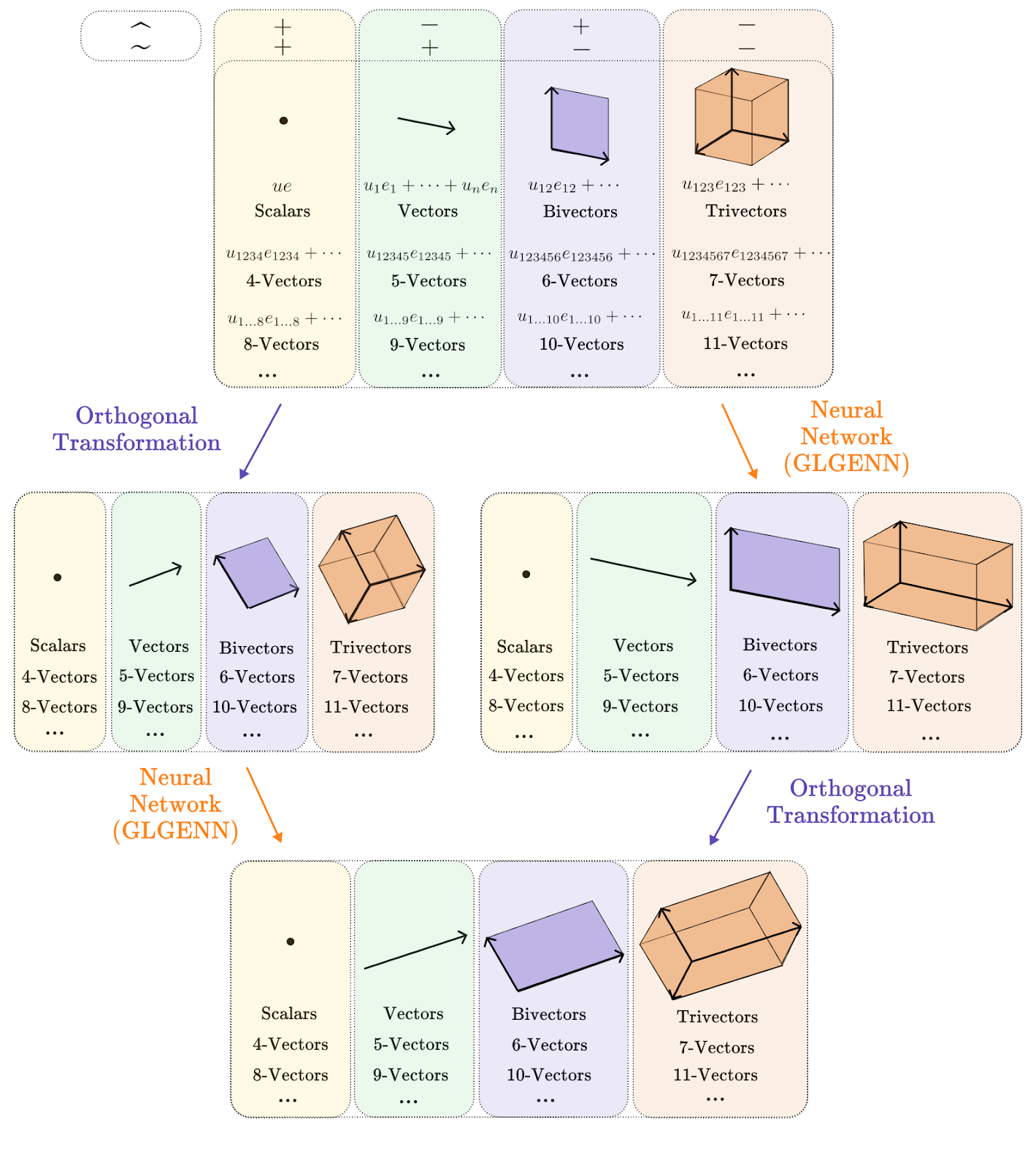
The model has been tested on a variety of tasks, ranging from simulating physical processes to handling geometric data, and has demonstrated results comparable to or better than existing methods. Additionally, GLGENN operates faster and more efficiently due to its reduced number of trainable parameters, making it more accessible for practical applications.

Dmitry Shirokov
'These results could mark a significant step toward the development of new neural-network tools for science and technology' adds Dmitry Shirokov, Head of the HSE FES Laboratory for Geometric Algebra and Applications. 'We are confident that the geometric-algebra approach will find applications across a wide range of fields, including bioinformatics, robotics, and geoinformatics.'
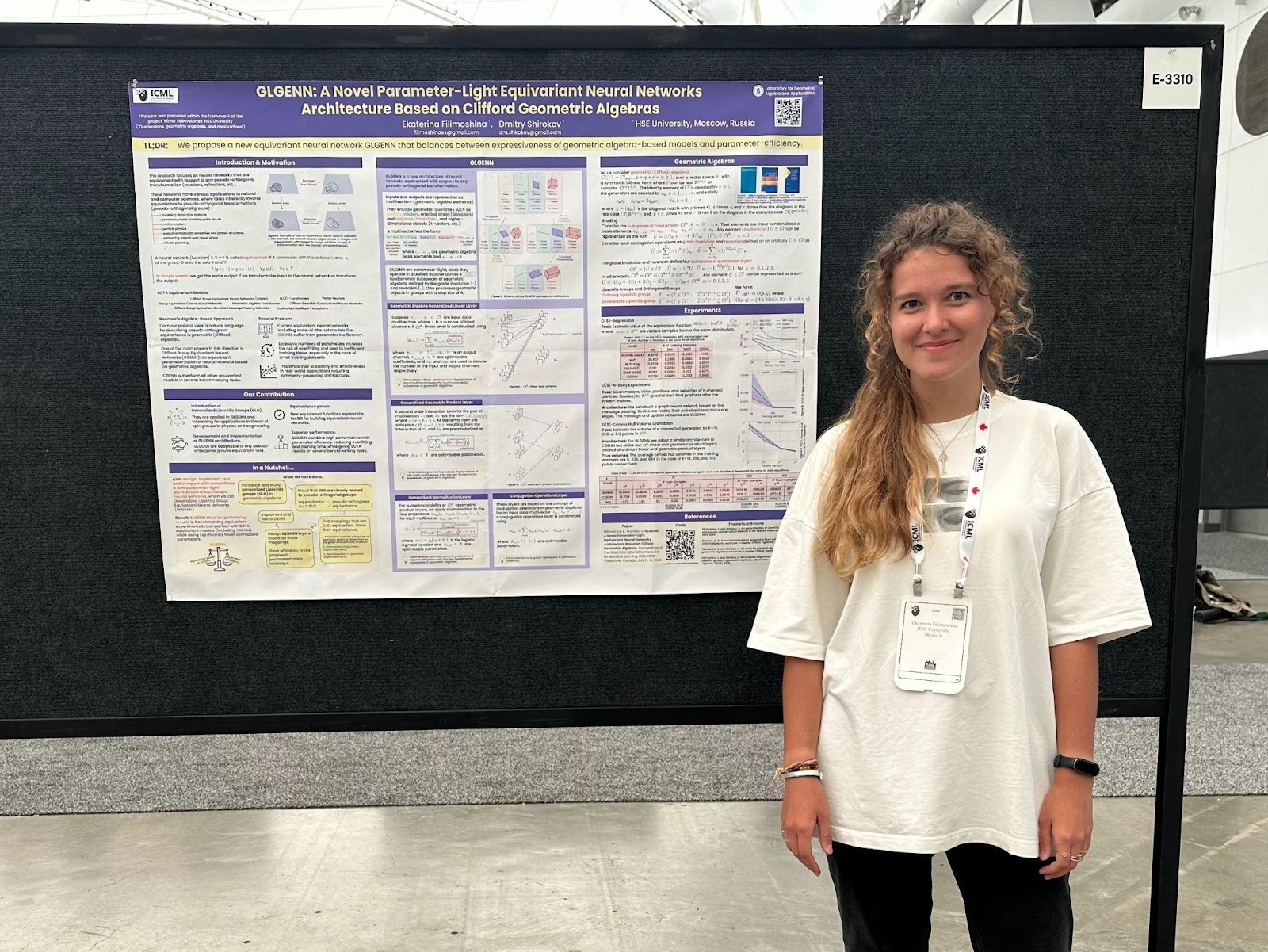
Participation in ICML served as recognition of the high level of machine learning research conducted at HSE University. The scientists plan to further develop the GLGENN architecture by expanding its capabilities to handle new types of data and exploring its potential applications in physics, robotics, and computer vision.
The study was supported by the HSE Mirror Laboratories project titled 'Quaternions, geometric algebras, and applications.'

See also:

Physicists at HSE University and FIAN Discover Way to 'Photograph' Sound for Testing Materials Used in 6G Communications
Researchers at HSE University, in collaboration with colleagues from the Lebedev Physical Institute of the Russian Academy of Sciences (FIAN), have developed a method for rapidly determining how firmly a film is bonded to a substrate. This is important for the creation of ultrahigh-frequency acoustic filters, which are key components of next-generation 5G and 6G communications. For the first time, researchers have succeeded in measuring the lateral rigidity of the bond between a two-dimensional material film and a substrate in this way. The study results have been published in Applied Physics Letters.
Biologists Discover Unique Properties of MiR-93-5p MicroRNA in Prostate Cancer
Researchers at the International Laboratory of Microphysiological Systems of the HSE Faculty of Biology and Biotechnology investigated how different isoforms of the same microRNA influence gene function in prostate adenocarcinoma. The study found that in some cases, microRNAs can reinforce each other’s effects by targeting and suppressing the same genes. This finding offers a fresh perspective on the molecular mechanisms underlying tumour development and on the search for disease biomarkers. The results have been published in PeerJ.
Researchers Discover How Spelling Errors Slow Down Reading in Russian
Psycholinguists from the Centre for Language and Brain at HSE University–St Petersburg have shown that words that are frequently misspelled are processed more slowly by readers, even when presented with the correct spelling. The researchers confirmed this effect for the first time using Russian-language materials and found that response speed is most strongly linked to how confidently individuals can distinguish the correct spelling of a word from an incorrect one. The study has been published in The Mental Lexicon.
HSE Economists Reveal How the Wage Gap Emerges Among Vocational School Graduates
HSE researchers examined the careers of 600,000 graduates of Russian secondary vocational education programmes and found that at the start of their careers, the gender wage gap reaches 23%, doubling after three years. This disparity is largely due to male and female students choosing different occupations when enrolling in vocational schools. These were the findings made by Sergey Roshchin, Natalya Yemelina, and Ksenia Rozhkova from of the HSE Faculty of Economic Sciences. The article has been published in Educational Studies.
HSE Researchers Make Aldehydes Perform Dual Function
Chemists from HSE University have discovered a way to carry out a reductive addition reaction without using an external reducing agent. Instead, the required 'resource' is supplied by the aldehyde itself, one of the reaction participants. This approach helps prevent unwanted side reactions, reduces toxicity, and simplifies the production and synthesis of organic molecules, including those used in the manufacture of medicines. The study has been published in Journal of Catalysis.
HSE Scientists Develop Method to Compress Large Language Models Without Losing Quality
Researchers from the AI and Digital Science Institute at the HSE Faculty of Computer Science have developed a new compression method for large language models such as GPT and LLaMA that reduces their size by 25–36% without additional training or significant loss of accuracy. This is the first approach to use mathematical transformations—specifically, rotations of model weights—to make models more amenable to compression with structured matrices. The study results have been published in ACL Findings 2025. The code is available on GitHub.
Machine Learning Models Can Help Reduce Volatility and Boost Stock Market Returns
The use of machine learning models makes it possible to achieve greater accuracy in predicting risks in the Russian stock market compared to classical econometric approaches. The predictive power of these models increases by 23%, while the average investor’s return can reach up to 13% per annum. These conclusions were drawn by Nikita Lysenok from the Department of Financial Market Infrastructure at the HSE Faculty of Economic Sciences. The paper has been published in Fundamental and Applied Mathematics.
HSE Study Reveals Imbalance in the Generative AI Market
Researchers at HSE University analysed how effectively the global generative artificial intelligence market converts investment into real revenue, concluding that AI is currently developing faster than it is paying off. The results have been published in the journal Foresight and STI Governance.
Living with Volcanoes and Tsunamis
It is not easy to get university graduates and students interested in living and working in Kamchatka, a remote region with harsh natural conditions and an extreme climate. Mirror Laboratories, a joint project of the HSE Institute of Education and Kamchatka State University (KamGU), encourages the development of ‘explorer’ competencies and the modernisation of the region’s education system. The HSE News Service discussed the project with Taras Pashchenko, Chief Expert of the HSE Laboratory for Curriculum Design.
Teaching a Machine to Read the Past: HSE Develops Neural Network to Decipher Manuscripts
Diaries and letters are an invaluable resource for humanities scholars. But what can be done when the text is impossible to read? At the HSE Faculty of Humanities, this challenge has been translated into the language of mathematics: a team of philologists, historians, and machine learning specialists has created an information system that not only recognises illegible handwriting but also helps analyse archival content.