

HSE and China’s Top Universities to Launch Large-Scale Research and Education Projects
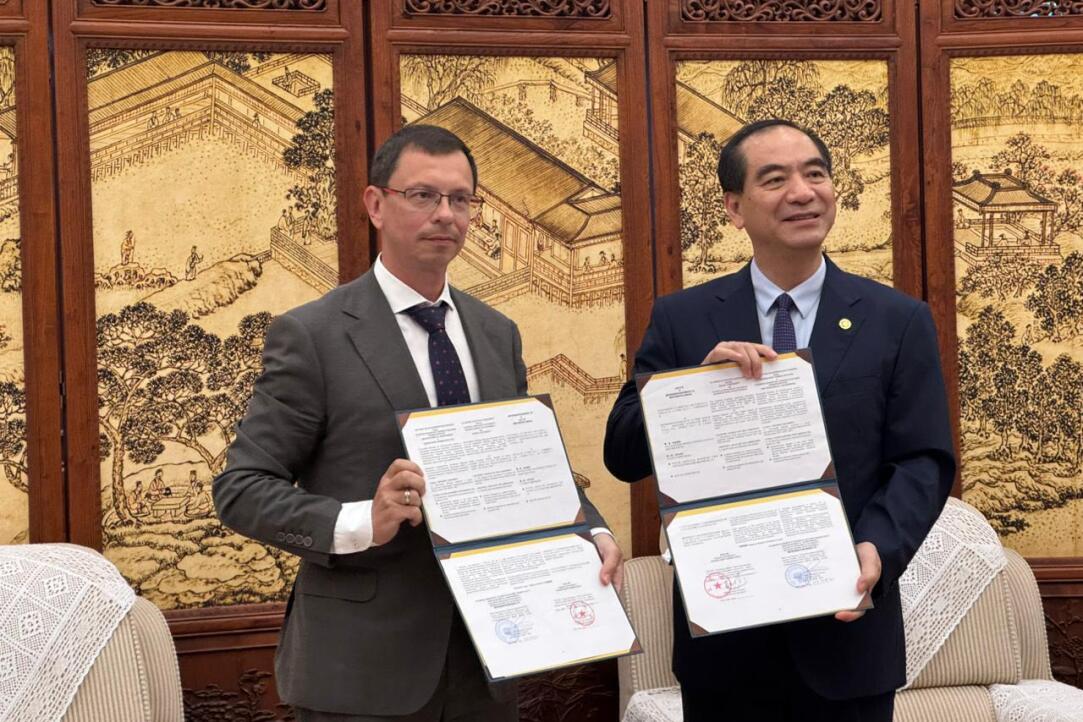
As part of the official visit of Russian President Vladimir Putin to the People’s Republic of China, the HSE delegation led by Rector Nikita Anisimov concluded new cooperation agreements with major Chinese universities. The agreements are designed to expand bilateral partnerships in education, science, and cultural exchange.
During the visit, the HSE University delegation met with the leadership of Tsinghua University, Peking University, and Beijing University of Technology, China’s top scientific and educational centres.
HSE Rector Nikita Anisimov
‘The strong overcome obstacles, and the wise overcome the entire journey. Cooperation with leading Chinese universities not only opens up new horizons in scientific research and knowledge exchange for Russian universities but also reinforces our position in the international educational space, serving as a key component of humanitarian cooperation between the Russian Federation and the People’s Republic of China. Together with our Chinese partners, today we took another important step towards mutual progress and prosperity.’
During the negotiations with our Chinese partners, two key agreements were signed. The first agreement with Tsinghua University focuses on the development of joint projects in the field of biology, ranging from molecular and computational neuroscience to AI-assisted big data analysis. This includes the formation of research groups, preparation of research publications, organization of internships for undergraduates and doctoral students, as well as holding of scientific and educational events. HSE doctoral students will have the opportunity to take internships at Tsinghua, while undergraduates will gain access to new academic mobility formats. The two universities also plan to launch dual degree programmes.
The academic exchange agreement signed with Peking University provides for an annual exchange of undergraduate and doctoral students. This document stipulates the procedures for selecting and assisting participants, their accommodation, administrative and visa support, and academic integration at the host institution. The agreement was published on the Kremlin website as one of the documents signed following the talks between the leaders of Russia and China.

In addition, during their visit, HSE representatives held separate meetings with Peking University units—in particular, with the School of Physics and the School of Management. They discussed the prospects for launching joint educational programmes, developing research initiatives, and participating in international grant competitions. The meetings were attended by HSE Vice Rector Victoria Panova, HSE MIEM Vice Rector and Director Dmitry Kovalenko, HSE MIEM Professor Andrey Vasenko, Dean of the HSE Faculty of Computer Science Ivan Arzhantsev, and Dean of the HSE Faculty of World Economy and International Affairs Anastasia Likhacheva.
The development of humanitarian cooperation and cultural exchange was among the key topics discussed at all the venues. The parties expressed interest in expanding programmes for learning Chinese in Russia and Russian in China, supporting youth initiatives and deepening academic dialogue between university communities.
HSE representatives also met with the university’s students and graduates studying or working in China. During their informal conversation, they shared experiences of participating in academic mobility programmes, talked about their professional plans, and discussed opportunities for future joint projects.

See also:

‘There’s a Big Practical Component in My Programme—That’s Especially Important in This Field’
Zou Jiaxu moved to Moscow from Heihe, China, at a young age. Having finished high school in Moscow, she decided to enrol in the Bachelor’s in Media Communications at the Institute of Media of the HSE Faculty of Creative Industries. Now in her second year of studies, Zou talked to the HSE News Service about the opportunities for practical experience available to HSE students, her volunteering and extracurricular activities, why learning Russian is a never-ending process, and the importance of making friends wherever you go.
A New Section on AI and a Prizewinning Paper: Early-Career HSE Researchers Take Part in IEEE EDM Conference
The 27th IEEE International Conference of Young Professionals in Electron Devices and Materials (EDM) has taken place in the Altai Republic. This year, researchers from HSE University presented the results of their research and were involved in organising a new section on artificial intelligence. A paper by HSE master’s student Rodion Sidorenko was awarded third place in the research paper competition at the conference.
HSE and Karakalpak State University Agree on Cooperation
HSE University and Berdakh Karakalpak State University have signed a cooperation agreement to strengthen collaboration in research, education, and innovation. Through the expertise of its Сentre of Digital Technologies for Nature-Based Solutions of the Carbon Measurement Supersites Programme, HSE University will work with colleagues from Uzbekistan to assess climate risks and evaluate opportunities for implementing nature-based climate projects in the region. The partners also plan to develop joint research and educational programmes.
HSE Initiates Development of Ethical Standard for Anthropomorphic Robots
Beyond technological solutions, the development of anthropomorphic robotics also demands ethical ones. In July 2026, the HSE Institute for Robotics Systems hosted a foresight session dedicated to developing an Ethical Standard for Anthropomorphic Robotic Complexes. Representatives from businesses, government bodies, scientific organisations, and universities gathered to discuss key ethical and legal issues surrounding the development of anthropomorphic robotic complexes. The main outcome of the meeting was a draft of the Ethical Standard.
International Dialogue and New Approaches: Highlights from Fudan University’s Summer School
At the beginning of July 2026, students from the HSE Faculty of World Economy and International Affairs took part in the Summer School on International Relations organised by Fudan University (China), one of the leading international educational programmes in this field. Over the course of two weeks, they explored contemporary approaches to global governance and the development of the Global South, attended lectures by renowned scholars from around the world, and discussed current international issues with fellow students from across the globe.
‘We Are Always Open to Collaboration, and China Is One of Our Most Important Partners’
From July 20 to 27, 2026, the HSE Faculty of Urban and Regional Development (FURD) is hosting a summer school for students from Tianjin University dedicated to the preservation of cultural heritage. Throughout the week, participants have attended lectures, practical workshops, and field visits to some of Moscow’s most iconic heritage sites. The summer school is the faculty’s first international programme of this kind and forms part of the expanding educational cooperation between Russia and China.
Physicists at HSE University and FIAN Discover Way to 'Photograph' Sound for Testing Materials Used in 6G Communications
Researchers at HSE University, in collaboration with colleagues from the Lebedev Physical Institute of the Russian Academy of Sciences (FIAN), have developed a method for rapidly determining how firmly a film is bonded to a substrate. This is important for the creation of ultrahigh-frequency acoustic filters, which are key components of next-generation 5G and 6G communications. For the first time, researchers have succeeded in measuring the lateral rigidity of the bond between a two-dimensional material film and a substrate in this way. The study results have been published in Applied Physics Letters.
HSE University and Peking University Expand Their Partnership
Peking University President Gao Song paid his first visit to HSE University as part of his first overseas trip since taking office in May 2026. The main purpose of the talks was to consolidate existing areas of cooperation and expand joint projects between HSE University and Peking University within the framework of the Cross Years of Russia–China Cooperation in Education (2026–2027).
HSE University to Launch New AI Supercomputer
HSE University is preparing to launch its second supercomputer. The new cluster will be primarily dedicated to artificial intelligence (AI) workloads and will complement the existing cHARISMa supercomputer. It is scheduled to become operational by the end of 2026.
HSE MIEM Students to Develop Two Satellites from Scratch for Orbital Experiments
The devices, created by student teams, will conduct space research on the properties of promising solar cells, on-board energy storage systems, and serial electronics for student satellites.